
And How to Audit It in an Afternoon
One of the things I’ve noticed over the last thirty years is that recruitment businesses almost never wake up one morning and decide they’re going to build an overcomplicated technology stack. Nobody sits in a board meeting and says, “Let’s buy seven different systems that don’t really talk to each other, create endless duplicate data and quietly chip away at our margin every single month.”
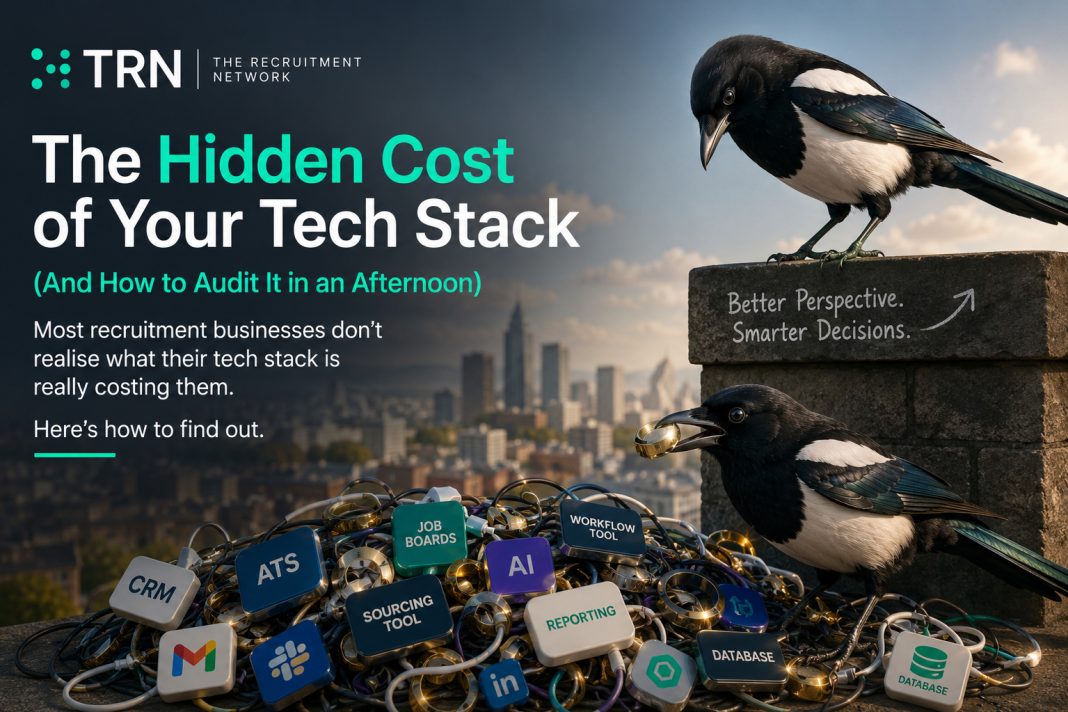
It just… happens. I was like a magpie to this stuff myself!
A few weeks ago, I was sitting with the leadership team of a recruitment business, talking through where they felt the pressure was in the business. Like most conversations these days, AI came up, automation came up, productivity came up, and then somebody casually mentioned what they thought they were spending on technology.
‘Thought they were spending’. That wording caught my attention. So, we started writing everything down by way of a terrifying tech inventory.
Recruiter licences. CRM. ATS. Job boards. A sourcing platform. Reporting software. A purchased database. A couple of AI subscriptions. Some workflow automation. A handful of those £49 and £99 monthly subscriptions that creep onto the company card and quietly become permanent. By the time we’d finished adding it all up, we were just shy of £16,000 every month.
The surprising part wasn’t the number, rather that nobody in the room knew it. It sat in the shadows of the P&L and the angsty faces of the recruiters I saw on that day as they likely struggled with log in fatigue!
This wasn’t a badly run business. Quite the opposite. Good people. Successful recruiters. Strong leadership. They simply hadn’t looked at the whole picture for a long time because, like most recruitment businesses, every purchase had made perfect sense at the time because it solved a problem that existed in isolation at the time, and the vendors were very persuasive.
That’s how tech stacks grow. One system gets bought because the CRM isn’t quite doing what you need. Then someone wants a better sourcing database. Marketing buys something to help with campaigns. Sales wants sequencing software. Someone discovers a shiny AI tool that promises to save five hours a week. Before long, you’ve got half a dozen platforms, several overlapping subscriptions and, somewhere in the middle of it all, one poor soul in operations spending half their life making sure the data in one system vaguely resembles the data in another.
I sometimes joke that the most expensive integration in recruitment isn’t an API. It’s that person sat trying to make sense of it all.
What’s interesting is that TRN’s own benchmarking suggests this isn’t an isolated story. Members are looking harder than ever at suppliers, reviewing contracts and questioning whether they’re actually getting value from what they’ve accumulated over the years. Technology has become one of the biggest areas of scrutiny, and rightly so.
But I wonder whether we’re sometimes asking the wrong question. Most people immediately ask whether a piece of software is expensive. I think a much better question is whether it’s unique. If you took it away tomorrow, what would genuinely stop happening?
Not what might happen. Not what somebody fears could happen six months from now. What would actually stop? It’s amazing how often the answer is, “Not very much.”
One of the reasons I think this problem has become so common is that nobody ever owns the technology stack as a whole. Operations owns one bit. Sales owns another. Finance signs the invoices. Marketing has a few subscriptions. Every decision is individually sensible, but nobody steps back often enough to ask whether the collection still makes sense. Then there’s the fear of cancelling anything.
I’ve seen businesses continue paying thousands of pounds a year for software because someone once said, “Let’s just keep it for now, in case we need it.” That phrase has probably cost the recruitment industry millions. The hidden cost, though, isn’t actually the software. It’s the people.
It’s the consultant copying notes from one platform into another because the systems don’t integrate. It’s downloading a CSV from one application just so it can be uploaded into another. It’s maintaining two databases because nobody quite trusts either of them.
Those little five-minute jobs happen hundreds of times every week, but because they’re spread across an entire business, nobody ever sees the total cost. If I was walking into a recruitment business tomorrow and had just one afternoon to help improve profitability, I probably wouldn’t start by looking at sales performance. I’d ask for a list of every technology subscription the business pays for and who uses it, and how often.
What does it actually do? What would happen if it disappeared tomorrow? And perhaps most importantly, what other system already does something very similar?
I also like looking at technology spend as a percentage of Net Fee Income rather than simply the monthly bill. A £4,000 monthly stack might be brilliant value for one business and completely unjustifiable for another. Without context, the number itself doesn’t tell you very much. The point isn’t to build the cheapest tech stack in recruitment. That would be just as daft. Some systems genuinely earn every penny you spend on them.
The point is simply to know what you’ve actually got, why you’ve got it and whether it’s still solving the problem you originally bought it for. If there’s one thing I’ve learnt after thirty years in this industry, it’s that recruitment businesses rarely have a technology problem. They usually have an accumulation problem.