
AI has quickly become one of the most talked-about developments in recruitment technology.
From CV parsing and candidate matching to automated outreach and intelligent assistants, recruitment businesses are being presented with more ways than ever to work faster.
But adding AI to an inefficient recruitment process does not automatically make it better.

In many cases, it simply allows the same problems to happen more quickly.
AI Is Only as Effective as the Process Behind It
Recruitment teams rarely struggle because they lack technology. More often, the real issue is that their technology does not reflect how they actually work.
Candidate information is stored across different systems. Consultants rely on spreadsheets or personal notes. Tasks are completed manually because workflows have not been properly configured. Valuable data is captured, but rarely used to guide decisions.
Introducing AI into this environment may create short-term efficiencies, but it does not address the underlying problem.
If candidate data is incomplete, an AI matching tool will produce weaker recommendations. If recruitment stages are unclear, automation may trigger the wrong action. If consultants do not trust the system, they will continue working outside it.
AI cannot compensate for disconnected processes, poor-quality data or low user adoption.
Start With the Recruitment Workflow
Before deciding where AI should be introduced, recruitment businesses need to understand how work currently moves through the organisation.
Where does a vacancy begin? How are candidates sourced, screened and shortlisted? What information must be captured at each stage? Where do delays occur? Which tasks are being repeated unnecessarily?
These questions are less exciting than discussing AI, but they are far more important.
Once the workflow is clear, technology can be applied with purpose.
For example, AI could help to:
- Extract structured information from CVs
- Identify candidates with relevant skills and experience
- Draft personalised candidate or client communications
- Summarise consultant notes and previous interactions
- Highlight missing compliance information
- Recommend the next best action for a vacancy
- Surface candidates already within the database
The goal should not be to add AI everywhere. It should be to use it at specific points where it can remove friction, improve consistency or support better decisions.
Your Existing Data May Be More Valuable Than You Think
Recruitment businesses often invest heavily in attracting new candidates while overlooking the information already held within their systems.
Over time, the database becomes filled with CVs, placements, interview feedback, client preferences, compliance records and communication history. However, if this data is poorly structured or difficult to search, consultants cannot use it effectively.
This is where the combination of good data and well-designed AI becomes powerful.
Rather than starting every vacancy from zero, consultants can quickly identify relevant candidates who have already engaged with the agency. Previous feedback can provide context. Skills and experience can be compared more intelligently. Relationships that might otherwise have been forgotten can be rediscovered.
However, this only works when the underlying data is accurate, accessible and connected.
A smarter recruitment platform does not simply store more information. It makes that information useful.
Automation Should Support Consultants, Not Restrict Them
One concern surrounding recruitment automation is that it may make the candidate experience feel impersonal.
That risk is real when automation is poorly designed.
Candidates should not receive irrelevant emails because they matched a single keyword. Consultants should not be forced through rigid processes that do not reflect the reality of a particular placement. Clients should not feel that every interaction has been generated without context.
Good automation creates more time for meaningful communication.
It handles repetitive administration, prompts consultants when action is needed and ensures important steps are not missed. The consultant remains responsible for the relationship, while the system provides better information and reduces unnecessary work.
The strongest recruitment technology does not attempt to remove people from recruitment. It enables them to focus on the areas where human judgement, experience and empathy matter most.
The Real Opportunity Is Connected Intelligence
Recruitment technology is moving beyond standalone AI features.
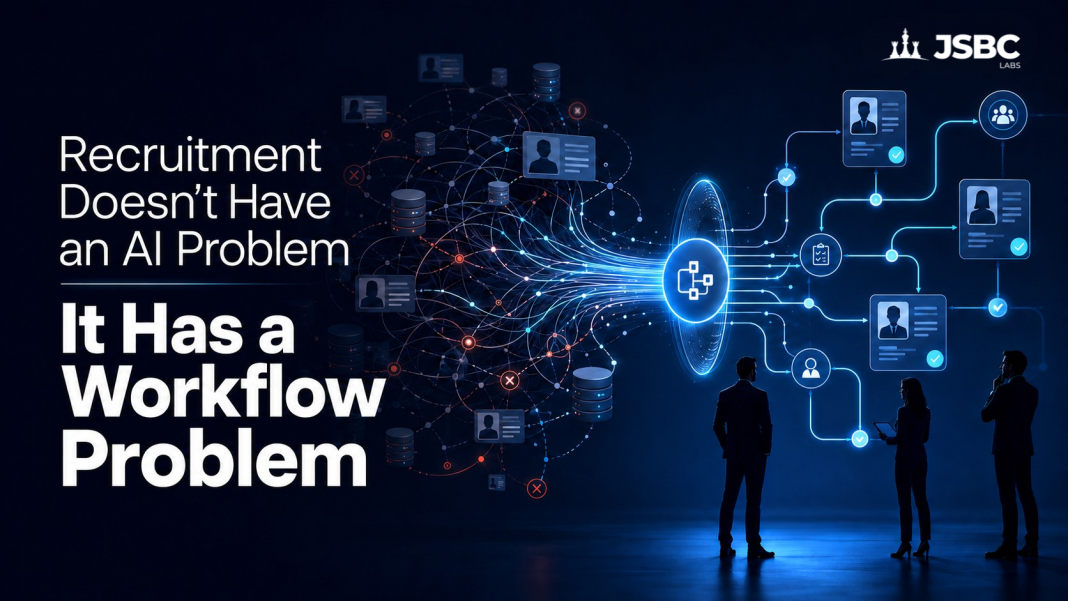
The bigger opportunity is to create a connected environment where data, workflows, automation and intelligence work together.
When a client creates a vacancy, the system can guide the required information. Relevant candidates can be surfaced based on meaningful criteria. Consultants can review suggestions and add their judgement. Communications can be prepared automatically but personalised before sending. Progress can be tracked without relying on separate spreadsheets. Managers can see where support or action is needed.
This is not AI operating separately from the recruitment process. It is intelligence embedded within it.
Build the Foundation Before Chasing the Feature
Recruitment businesses do not need to adopt every new AI feature immediately.
They need to identify the operational problems that are limiting growth and decide where technology can create measurable value.
That may mean improving data quality before implementing candidate matching. It may mean simplifying recruitment stages before creating automated workflows. It may mean redesigning the user experience so consultants actually want to use the system.
The businesses that gain the most from AI will not necessarily be those that adopt it first. They will be the ones that connect it to clear processes, reliable data and real user needs.
At JSBC Labs, we help businesses design and build practical Salesforce and digital solutions around the way their teams operate. Because successful transformation is not about adding another feature. It is about creating a better way of working.