
Salesforce has made its direction clear: the future of enterprise operations is AI-driven, autonomous, and deeply integrated into customer workflows. Agentforce is the clearest signal yet.
But while businesses are racing to explore AI agents, copilots, and automation, most organisations still haven’t solved the fundamentals – fragmented data, inconsistent processes, low user adoption, and disconnected customer journeys.
That’s the real challenge.
The conversation around Salesforce AI has accelerated dramatically over the past year. Every leadership team wants to understand how AI can improve productivity, reduce operational overhead, and create better customer experiences. The problem is that many organisations are trying to implement intelligent automation on top of operational inefficiency.
AI doesn’t fix broken processes. It scales them.
Agentforce has enormous potential because it shifts Salesforce from being a system of record to becoming a system of action. Businesses will be able to automate decisions, orchestrate customer interactions, and create far more proactive operating models. But none of that works effectively without trusted data, clear governance, and operational maturity underneath it.
This is where many Salesforce programmes are about to hit resistance.
We’re seeing businesses focus heavily on AI functionality without addressing the architecture and process design required to support it. In practice, that leads to disconnected outputs, poor adoption, and automation that creates more confusion than efficiency.
The organisations that will succeed with Agentforce won’t necessarily be the first to deploy it. They’ll be the ones that prepared properly.
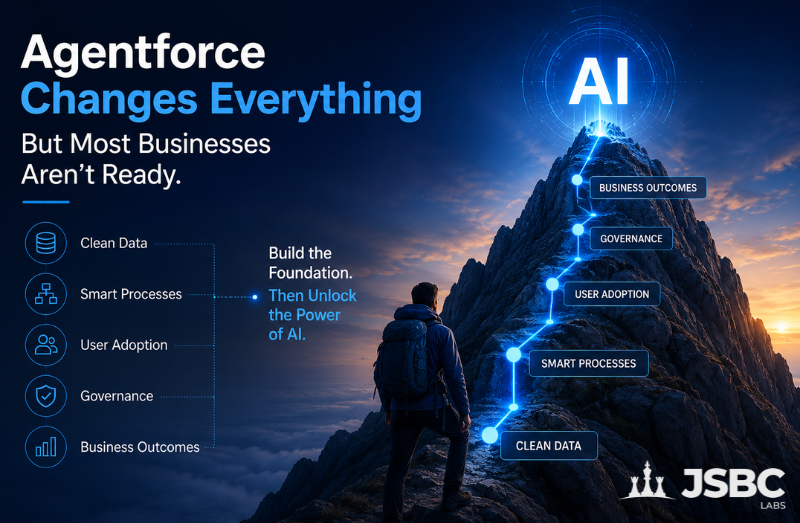
That means:
- Establishing clean and connected data structures
- Designing scalable operational workflows
- Improving Salesforce adoption internally
- Aligning automation with commercial outcomes
- Building systems that support decision-making, not just reporting
At JSBC Labs, we believe the next phase of Salesforce transformation is less about adding more technology and more about operational intelligence. AI is powerful, but only when the foundations beneath it are built correctly.
Businesses don’t need more AI noise. They need systems that are commercially aligned, operationally efficient, and ready to scale intelligently.
That’s the difference between experimenting with AI and actually transforming with it.