
Recruitment has always been a relationship-driven industry.
The strongest consultants remember which candidates are open to the right opportunity, which clients prefer a particular communication style and which conversations need to be followed up at exactly the right time.
That knowledge is valuable. But when it exists only in someone’s inbox, notebook or memory, it creates a risk for the entire recruitment business.
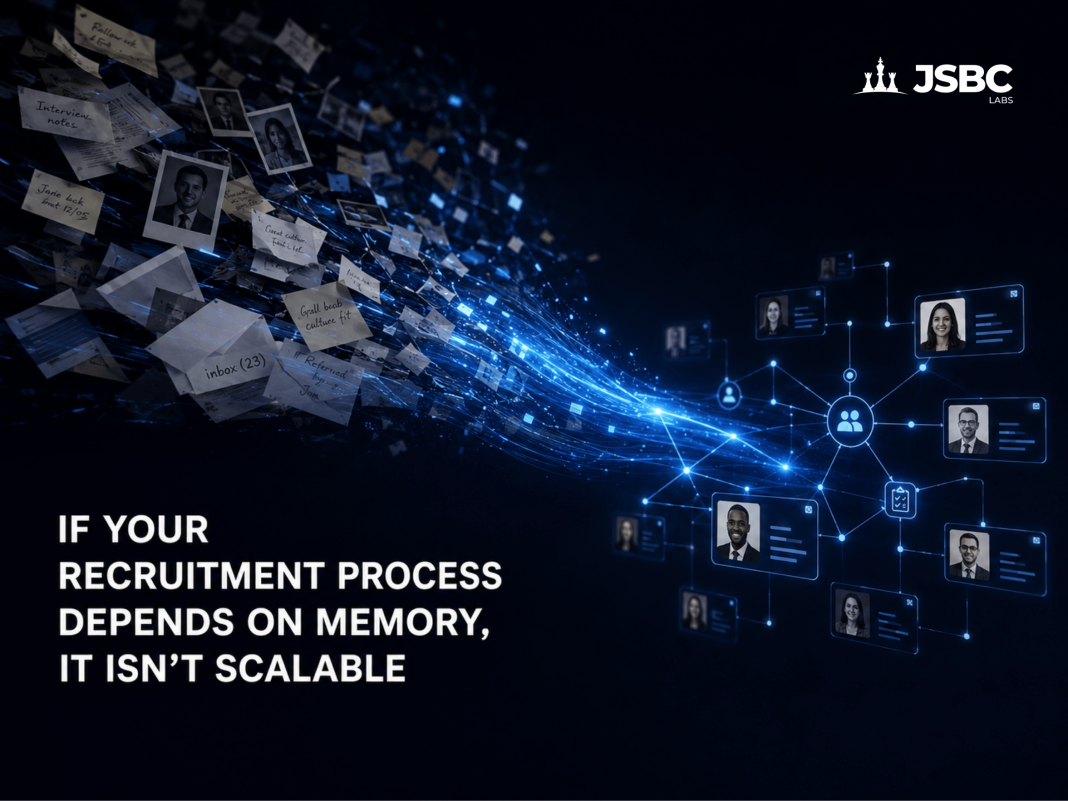
As an agency grows, it becomes impossible to manage every relationship through individual knowledge alone. Information becomes fragmented, opportunities are missed and the quality of service starts to depend on which consultant happens to be available.
A scalable recruitment business does not replace personal relationships with technology. It uses technology to ensure those relationships are supported, visible and protected.
The Problem With Consultant-Owned Information
In many recruitment businesses, consultants develop their own ways of working.
One may keep detailed notes in the CRM. Another may rely on email folders. Someone else may maintain a spreadsheet of priority candidates, while important client information sits inside private messages or handwritten notes.
This may work when the team is small, but it becomes increasingly difficult to manage as the business expands.
When information is not captured consistently:
- Candidate conversations are repeated unnecessarily
- Client preferences are overlooked
- Follow-ups depend on individual reminders
- Managers have limited visibility of activity
- Consultants struggle to cover one another’s work
- Valuable knowledge can leave when an employee does
The issue is not that consultants are doing something wrong. It is often that the system has not been designed to make the correct process simple.
If updating the CRM takes too long or does not provide any immediate value, consultants naturally find quicker alternatives.
A Database Is Not the Same as Organisational Knowledge
Most recruitment agencies already hold a significant amount of data.
They have candidate records, CVs, interview feedback, placement histories, client contacts, vacancy details and years of communication. Yet having information stored somewhere does not mean the business can use it effectively.
A database becomes genuinely valuable when teams can quickly understand:
- Who has engaged with a candidate or client
- What was discussed
- What action needs to happen next
- Which candidates may suit a new opportunity
- Why a previous application was unsuccessful
- What a client values when reviewing a shortlist
Without this context, consultants may be looking at thousands of records while still feeling as though they are starting every search from the beginning.
The goal should not simply be to capture more data. It should be to create a reliable source of shared knowledge that helps consultants make better decisions.
Consistency Should Not Mean More Administration
The traditional response to inconsistent data is often to introduce more required fields, longer forms and stricter processes.
This can create another problem: consultants spend more time maintaining the system and less time speaking to candidates and clients.
Consistency should come from thoughtful system design, not unnecessary administration.
Recruitment platforms can make information easier to capture by:
- Automatically logging relevant activity
- Using clear recruitment stages
- Prompting consultants for essential information
- Providing structured note templates
- Creating follow-up tasks automatically
- Showing recent interactions in one place
- Removing duplicate or unnecessary fields
When the system reflects the way consultants actually work, adoption improves naturally. Capturing information becomes part of the recruitment process instead of an additional task completed afterwards.
Shared Visibility Creates a Better Candidate Experience
Candidates notice when a recruitment business lacks joined-up information.
They may receive the same vacancy from multiple consultants, be asked to provide documents they have already submitted or need to explain their situation every time they speak to someone new.
These experiences can make candidates feel like records rather than people.
A connected system gives consultants immediate access to the context they need. They can see previous conversations, role preferences, availability, compliance progress and outstanding actions before making contact.
This allows communication to feel more personal, even when several team members are involved in the relationship.
It also improves continuity. If a consultant is unavailable, another team member can provide support without asking the candidate to start again.
Client Relationships Should Belong to the Business
Strong consultant-client relationships are an important competitive advantage. However, recruitment businesses also need to ensure those relationships are supported at an organisational level.
If all client knowledge sits with one account manager, the relationship becomes vulnerable.
A well-designed CRM should provide a clear view of the client’s history, including:
- Previous and current vacancies
- Key contacts and decision-makers
- Preferred candidate profiles
- Agreed rates and commercial information
- Past placements and feedback
- Communication history
- Outstanding opportunities and actions
This does not reduce the importance of the account manager. It gives them better information and allows the wider business to support the relationship more effectively.
It also helps management understand which relationships are growing, where engagement has slowed and where additional attention may be needed.
Automation Can Protect the Follow-Up Process
Recruitment opportunities are often lost through timing rather than capability.
A strong candidate is not contacted when a suitable vacancy becomes available. A client conversation is not followed up. An expiring document is noticed too late. A candidate who was unavailable six months ago is never approached again.
Consultants may intend to remember these actions, but no individual can reliably manage hundreds of changing relationships without support.
Automation can help by creating reminders, highlighting inactive records and triggering the correct next steps based on meaningful events.
The purpose is not to automate every conversation. It is to prevent valuable relationships from disappearing because someone became busy or an action was overlooked.
Building a Recruitment Business That Can Scale
Scalability is not simply the ability to add more consultants or process more vacancies.
It is the ability to grow without losing visibility, service quality or valuable knowledge.
Recruitment businesses need systems that allow their best practices to be repeated across the organisation. New employees should be able to understand the process. Managers should have access to reliable information. Candidates and clients should receive a consistent experience regardless of who handles the interaction.
The strongest recruitment technology does not attempt to replace the experience stored in a consultant’s mind. It turns that experience into shared, usable knowledge that strengthens the entire business.
At JSBC Labs, we design and build Salesforce and digital solutions around real business processes. We help teams connect their information, improve visibility and create workflows that support sustainable growth—because valuable relationships should never depend on one person remembering the next step.